Preserving Prosperity By Extending Health Span Of Society One Patient At A Time


Nee Soon Clinic
18 Mar 2026
Jaw Slimming Treatment in Singapore: Medical Guide to Masseter Botulinum Toxin Injection
Jaw Slimming Treatment in Singapore: Medical Guide to Masseter Botulinum Toxin Injection
Jaw slimming treatment using masseter botulinum toxin injection is a widely performed non-surgical facial contouring procedure in Singapore. It is commonly considered by individuals whose lower face appears broad, square, or heavy, often due to enlargement of the jaw muscles rather than bone structure.
The masseter muscles are among the strongest muscles in the human body and play a central role in chewing. In some individuals, these muscles become hypertrophic (enlarged) due to genetics, habitual jaw clenching, or chronic overuse. When the masseter muscles increase in size, the lower face can appear wider and more angular.
Masseter botulinum toxin injection works by temporarily reducing muscle activity, which allows the muscle to gradually decrease in volume over time. This may soften the contour of the lower face and create a more tapered jawline.
This article provides a comprehensive medical overview of jaw slimming treatment in Singapore, including anatomy, patient suitability, dosing considerations, expected outcomes, functional effects, and safety considerations.
Purpose of Jaw Slimming Treatment
Jaw slimming treatment aims to reduce excessive bulk of the masseter muscles while preserving normal chewing function.
The goals of treatment may include:
Softening a square or bulky lower face
Improving facial balance and proportions
Reducing visible jaw muscle prominence during clenching
Addressing muscle overactivity associated with jaw tension or bruxism
It is important to understand that jaw slimming injections do not change bone structure. They specifically target the muscle component contributing to jaw width.
Masseter Muscle Anatomy
The masseter muscle is a thick, quadrangular muscle located at the angle of the mandible (jawbone). It originates from the cheekbone and inserts along the lower jaw.
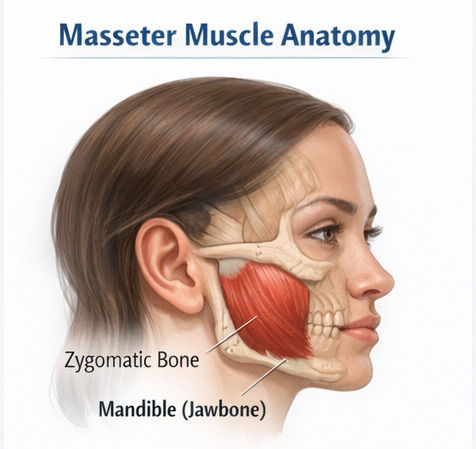
Key anatomical features include:
One of the primary muscles responsible for mastication (chewing)
Generates significant bite force
Works together with other jaw muscles such as the temporalis and pterygoids
When the teeth are clenched, the masseter muscle contracts and becomes easily palpable along the jawline.
Clinical imaging studies indicate that average adult masseter muscle thickness measures approximately 13–15 mm during maximal clenching, although this can vary significantly depending on gender, genetics, and chewing habits.
Causes of Masseter Muscle Enlargement
Enlargement of the masseter muscle is referred to as masseter hypertrophy. This condition may develop gradually over time and can contribute to a wider or more angular lower face.
Common contributing factors include:
Habitual jaw clenching or teeth grinding (bruxism)
Chronic stress leading to increased muscle tension
Frequent chewing activity
Genetic predisposition to stronger jaw muscles
Asymmetrical chewing habits
In many individuals seeking jaw slimming treatment, the jaw bone itself is normal and the apparent width of the lower face is primarily related to muscle hypertrophy rather than skeletal anatomy.
Distinguishing Muscle Hypertrophy from Jaw Bone Width
Not all wide jaws are caused by enlarged muscles. The lower face may appear broad due to skeletal structure, muscle bulk, or a combination of both.

A clinical examination helps differentiate between these causes.
Feature | Muscle Hypertrophy | Skeletal Jaw Width |
Prominence during clenching | Muscle bulge becomes more visible | Minimal change |
Palpation | Thick, soft muscle mass | Hard bony contour |
Response to muscle injections | Often improves jaw width | Limited effect |
Jaw slimming injections are most effective when muscle hypertrophy is a major contributor to facial width.
Clinical Assessment of the Masseter Muscle
A medical assessment typically includes:
Visual inspection of facial proportions
Palpation of the masseter muscle during clenching
Evaluation of jaw symmetry
Review of chewing habits and clenching patterns
In some cases, ultrasound imaging may be used to measure muscle thickness.
Degrees of Muscle Hypertrophy
Severity | Clinical Characteristics |
Mild | Slight muscle prominence mainly when clenching |
Moderate | Visible jaw width at rest and during expression |
Severe | Strong, bulky jaw muscles with pronounced square appearance |
Understanding the degree of hypertrophy helps guide appropriate dosing and treatment planning.
Dosing Principles for Masseter Botulinum Toxin Injection
There is no universal dose for jaw slimming treatment. Dosing must be tailored to each individual.
Factors influencing dosage include:
Masseter muscle thickness
Strength of jaw clenching
Facial width and proportions
Gender-related differences in muscle mass
Functional chewing tolerance
Clinical practice generally favours moderate dosing strategies to achieve gradual muscle reduction while preserving normal chewing function.
Overly aggressive dosing may increase the likelihood of temporary functional changes.
Treatment Procedure Overview
Jaw slimming treatment is typically performed in a clinical setting and does not require surgical incisions.
General Treatment Steps
Assessment of the masseter muscle while the patient gently clenches the teeth
Identification of the safe injection zone within the muscle
Administration of several small injections into the deep portion of the masseter
Observation after treatment if required
Procedure Duration
The treatment itself typically takes approximately 10–15 minutes.
Comfort and Sensation
Patients usually experience:
Brief needle sensation
Mild pressure during injection
Most individuals tolerate the procedure well without the need for significant analgesia.
Timeline of Jaw Slimming Results
Jaw slimming effects occur gradually as muscle activity decreases.

Time After Treatment | Expected Changes |
1–2 weeks | Initial reduction in muscle activity |
4–6 weeks | Noticeable jaw slimming |
8–12 weeks | Peak facial contour change |
3–6 months | Gradual recovery of muscle activity |
The degree of slimming varies depending on muscle size, anatomy, and individual response.
Duration of Effect
The effects of masseter botulinum toxin injection generally last approximately four to six months.
As nerve signalling returns:
Muscle contraction strength increases
Muscle thickness gradually returns toward baseline
Jaw width may slowly reappear
Some patients choose to repeat treatment periodically to maintain results, while others may prefer longer intervals between treatments.
Impact on Chewing and Jaw Function
Jaw slimming treatment can temporarily affect masticatory (chewing) function because the masseter muscle is one of the primary muscles responsible for generating bite force.

Clinical assessments evaluating jaw muscle activity and chewing performance have shown that:
A mild reduction in chewing strength or efficiency may occur after treatment
Most patients adapt quickly and continue normal eating without significant difficulty
The reduction in muscle activity is usually temporary, improving as nerve signalling gradually returns
Patients may notice subtle changes such as:
Slight fatigue when chewing very firm foods
A feeling that the jaw muscles are less strong during clenching
These changes are generally mild and resolve as muscle function recovers over time.
When treatments are performed too frequently without adequate recovery, muscle activity may remain suppressed for longer periods. For this reason, appropriate spacing between treatments is considered an important aspect of responsible clinical practice.
Safety Profile and Jaw Bone Considerations
Jaw slimming injections have been studied extensively in both aesthetic and functional medical settings. Available clinical evidence indicates that the treatment has an acceptable safety profile when performed appropriately.
Long-term follow-up studies evaluating patients who underwent masseter botulinum toxin treatment have reported:
No clinically significant damage to the mandible (jaw bone)
No harmful changes in dental alignment or bite mechanics
No evidence of pathological bone resorption when treatment is used appropriately
Because the treatment works by modulating muscle activity rather than altering skeletal structure, the underlying jaw bone remains unchanged.
As with any medical procedure, safety depends on:
Proper patient assessment
Accurate injection technique
Appropriate dosing
Reasonable intervals between treatments
When these principles are followed, jaw slimming treatment is generally considered well tolerated in appropriately selected patients.
Side Effects and Potential Complications
Most side effects are temporary and self-limiting.
Common effects may include:
Mild jaw tiredness
Temporary chewing fatigue
Injection site tenderness or swelling
Less common effects include:
Temporary asymmetry in jaw muscle strength
Mild changes in facial expression if adjacent muscles are affected
Serious complications are rare when treatment is performed with appropriate technique and dosing.
Functional Benefits Beyond Facial Slimming
In addition to aesthetic contouring, some patients experience improvement in symptoms related to jaw muscle overactivity.

Possible benefits may include:
Reduced jaw clenching intensity
Decreased jaw muscle tension
Improvement in tension-related headaches
Less fatigue in the jaw muscles
These effects vary between individuals and should not be considered guaranteed outcomes.
Post-Treatment Recovery and Care
Most patients resume normal activities shortly after treatment.
Typical recommendations include:
Avoid massaging the treated area for several hours
Avoid excessive jaw activity immediately after treatment
Maintain normal eating unless discomfort occurs
Mild sensations such as jaw tightness or fatigue may occur temporarily and usually resolve without intervention.
Frequently Asked Questions
Is jaw slimming permanent?
No. The effects are temporary and gradually wear off as muscle activity returns.
Will jaw slimming make my face sag?
Gradual reduction in muscle size allows surrounding tissues to adapt, so sagging is uncommon in appropriate candidates.
Can jaw slimming affect chewing?
Some patients experience mild chewing fatigue initially, but most adapt quickly and normal function typically returns.
How often is repeat treatment needed?
Many individuals notice effects lasting four to six months, although treatment intervals vary depending on individual response.
Does jaw slimming change the jaw bone?
No. The treatment affects muscle activity and does not alter the bone structure of the jaw.
Disclaimer:The information provided in this article is for informational purposes only and is not intended as a substitute for professional medical advice, diagnosis, or treatment. Always seek the advice of your physician or other qualified health provider with any questions you may have regarding a medical condition. The content is not intended to be a comprehensive source of information and should not be relied upon as such. Reliance on any information provided in this article is solely at your own risk. The authors and the publisher do not endorse or recommend any specific tests, physicians, products, procedures, opinions, or other information that may be mentioned in the article. Any reliance on the information in this article is solely at the reader's own risk.
779 Yishun Ave 2, #01-1547, Singapore 760779
Tel: 6721 9796
