Preserving Prosperity By Extending Health Span Of Society One Patient At A Time


Nee Soon Clinic
25 Sept 2026
Microtox Singapore: Microbotulinum Toxin for Pores, Oily Skin, Skin Texture & Scars
Microtox in Singapore, also known as microbotulinum toxin or intradermal Botox, is a versatile aesthetic treatment that may help improve enlarged pores, oily skin, fine lines, uneven skin texture, facial redness, jawline definition, neck lines and selected surgical scars, hypertrophic scars and keloids.
Microtox in Singapore at a Glance - Why choose Nee Soon Clinic
COST $180-360Value for money | DURATION 3-5 minsProcedure Time |
PAIN SCORE 0-1VAS Score Patient Reported | DOWNTIME 0 daysReturn to work immediately |
EXPERIENCE >10 yearsHighly Professional Doctor | RESULTS 2 weeksObservable results |
Individual results vary.
Microtox, also called microbotulinum toxin, intradermal botulinum toxin or microdroplet botulinum toxin, is a technique in which small amounts of botulinum toxin type A are injected superficially at multiple points across the skin.
Unlike conventional botulinum toxin treatment, which usually targets specific facial muscles, Microtox is placed mainly within the intradermal or very superficial subdermal plane.

Depending on the indication, Microtox may be considered for:
enlarged pores
excessive sebum and oily skin
fine superficial lines
uneven skin texture
selected facial redness or flushing
subtle lower-face and jawline refinement
superficial neck lines and platysmal activity
selected postoperative scars
hypertrophic scars and keloids as part of scar management
The technique, dose, depth and treatment pattern vary significantly according to the clinical problem.
A pore treatment is not performed in the same way as treatment for a fresh surgical scar or a hypertrophic scar.
What Is Microtox Singapore?
Microtox uses multiple small-volume injections of botulinum toxin type A placed superficially across the skin.
The objective is usually not complete muscular paralysis.
Superficial administration may influence:
superficial muscle fibres attached to the skin
sebaceous activity
cholinergic signalling
sweat gland activity
cutaneous neurovascular signalling
local inflammatory pathways
mechanical tension across selected scars
This makes Microtox a different treatment strategy from deeper neuromuscular injection.
How Does Microtox Work?
Botulinum toxin type A inhibits acetylcholine release from cholinergic nerve endings by interfering with proteins required for neurotransmitter release.
Its best-established effect is reduction of muscle contraction.
With intradermal treatment, additional effects may occur within the skin and superficial tissues.
1. Sebum Regulation
Clinical studies suggest that intradermal botulinum toxin may reduce facial sebum production.
Possible mechanisms include modulation of:
cholinergic signalling
arrector pili activity
sebaceous gland signalling
surrounding neural pathways
In a prospective study of patients with oily skin, sebum production was significantly reduced at:
1 week
1 month
2 months
3 months
after intradermal treatment.
Approximately 91% of participants reported satisfaction, with subjective improvement in oiliness.
Microtox Singapore for Oily Skin
Excess facial sebum can contribute to:
persistent shine
enlarged pores
makeup instability
congestion
comedones
acne-prone skin

For suitable patients, Microtox may reduce excessive sebum activity without eliminating normal sebaceous function.
Clinical studies and systematic reviews have reported measurable reductions in sebum production after intradermal botulinum toxin treatment.
The effect may be particularly useful in patients with both oily skin and prominent pores.
Microtox for Enlarged Pores
Pore visibility is influenced by several factors:
sebaceous activity
skin elasticity
age
acne
follicular structure
ultraviolet exposure
genetics
Microtox does not remove pores.
Instead, reduced sebum activity and changes in superficial tissue tension may make pores appear less prominent.
A clinical study using diluted intradermal incobotulinumtoxinA found improvement in:
sebum production
pore appearance
facial laxity
lower-face contour
Changes were detectable at approximately 1 week, greatest at around 4 weeks, and remained measurable at 12 weeks.
Meta-analyses have also reported statistically significant improvements in pore measurements, although treatment protocols vary considerably between studies.
Microtox for Skin Texture
Microtox is increasingly studied as a skin-quality treatment.
Reported improvements include:
smoother texture
reduced facial shine
reduced pore prominence
improvement in fine lines
subtle tightening
improved surface regularity
A systematic review and meta-analysis evaluating intradermal botulinum toxin studies reported improvement in:
sebum production
pore size
skin texture
wrinkles
erythema
selected lifting or elasticity parameters
However, the evidence did not demonstrate a consistent increase in skin hydration.
Microtox should therefore not be considered a hydration treatment.
Microtox for Fine Lines
Fine lines can result from repeated superficial muscular activity, loss of elasticity, photodamage and dermal ageing.
Microtox may reduce superficial muscular pull while preserving more natural movement than deeper neuromuscular treatment.
It may be considered for:
fine cheek lines
superficial lower-face lines
subtle forehead texture
fine neck lines
Deeper folds caused by volume loss, marked laxity or structural ageing usually require a different treatment approach.
Microtox for Facial Contouring
Microtox may be used in selected patients to influence superficial depressor muscles and platysmal fibres.
Treatment areas can include:
lower face
jawline
mandibular border
chin
corners of the mouth
upper neck
platysmal region
Clinical studies have reported improvement in:
jawline definition
lower-face contour
jowling
superficial platysmal activity
selected neck contour parameters
The effect is usually subtle refinement, not structural lifting.
Microtox for the Jawline and Neck
The lower face is influenced by several muscles, including:
platysma
depressor anguli oris
depressor labii inferioris
mentalis
orbicularis oris
Superficial microdroplet treatment can be used to reduce selected superficial downward pull.
Potential treatment goals include:
improved mandibular definition
softer neck creases
reduced superficial platysmal banding
refinement of the lower-face contour
Because the muscles controlling the mouth and smile are closely positioned, precise injection depth and placement are essential.
Excessive diffusion may temporarily alter facial movement.
Microtox for Facial Redness
Intradermal botulinum toxin has also been studied for persistent facial erythema and flushing.
Potential mechanisms include modulation of:
neurogenic inflammation
cholinergic signalling
vascular activity
inflammatory neuropeptides
Randomised clinical studies in patients with erythematotelangiectatic rosacea have reported reductions in:
clinician-assessed erythema
objectively measured redness
vascular density
background erythema
This remains a specialised indication.
Facial redness should be properly diagnosed before treatment.
Microtox for Post-Acne Redness
Microtox has also been investigated for post-acne erythema.
Clinical data suggest possible improvement in:
erythema
sebum production
persistent post-inflammatory redness
However, post-acne redness is different from structural acne scarring.
Atrophic acne scars such as:
ice-pick scars
boxcar scars
rolling scars
involve loss, tethering or remodelling of dermal tissue.
Microtox alone is unlikely to correct substantial structural acne scarring.
Microtox for Scars
Scar treatment requires accurate diagnosis.
A scar may be:
newly healed
red and immature
widening
hypertrophic
keloidal
mature and flat
depressed
tethered
painful
itchy
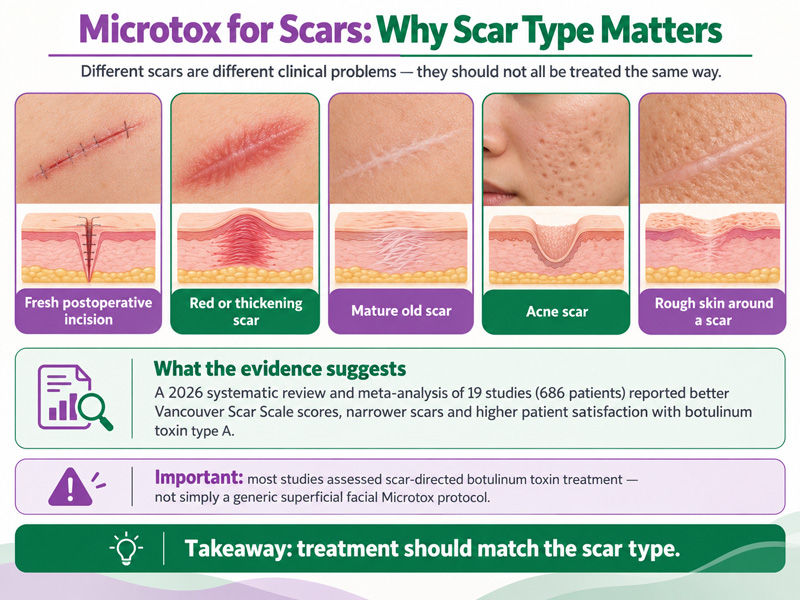
These scar types behave differently and should not receive the same treatment by default.
Botulinum toxin type A has been studied particularly for:
postoperative scar prevention
facial surgical scars
hypertrophic scars
keloids
The treatment technique may involve superficial injection, perilesional injection or direct scar-directed injection depending on the indication.
Why Botulinum Toxin May Help Surgical Scars
A healing incision is affected by mechanical tension.
Repeated movement from underlying muscles may increase force across an immature wound.
This can contribute to:
scar widening
increased thickness
inflammation
less favourable collagen organisation
Temporary reduction of muscular contraction can decrease tension across the healing incision.
This concept is sometimes described as chemical immobilisation of the wound environment.
Reducing mechanical stress during early healing may support a narrower and more cosmetically favourable scar.
Evidence for Botulinum Toxin in Surgical Scars
A 2026 systematic review and meta-analysis evaluated 19 studies involving 686 patients.
Compared with control treatment, botulinum toxin type A was associated with statistically significant improvements in:
Vancouver Scar Scale
scar width
visual scar appearance
Stony Brook Scar Evaluation Scale
Patient and Observer Scar Assessment Scale
patient satisfaction
Reported pooled differences included:
Vancouver Scar Scale: approximately -1.07
scar width: approximately -0.21
visual analogue scar score: approximately +1.18
Stony Brook Scar Evaluation Scale: approximately +1.64
patient satisfaction: approximately 1.8 times higher
Adverse effects were generally mild and temporary.
The available studies nevertheless used different doses, injection techniques and surgical sites.
Microtox After Surgery
Some studies have investigated botulinum toxin soon after wound closure.
Published protocols have included treatment:
immediately after surgery
within the first several days after surgery
Randomised facial scar studies have reported improvements in measures such as:
scar width
scar height
overall visual appearance
The rationale is strongest where muscle movement places substantial tension across a cosmetically important wound.
Scar treatment must still be coordinated with:
wound closure
postoperative care
infection prevention
scar maturation
Microtox for Hypertrophic Scars
Hypertrophic scars remain within the boundaries of the original injury but may become:
raised
firm
red
itchy
uncomfortable
Their development involves excessive fibroblast activity and collagen deposition.
Botulinum toxin has been investigated for possible effects on:
fibroblast activity
transforming growth factor signalling
collagen synthesis
mechanical tension
inflammatory signalling
A systematic review and meta-analysis of randomised trials reported significant improvement in overall Vancouver Scar Scale scores.
Pooled improvement was approximately:
-1.69 points.
Scar pliability also improved significantly.
However, improvement in individual components such as pigmentation, vascularity and height was not consistent across all studies.
Microtox for Keloids
Keloids differ from hypertrophic scars because they extend beyond the original wound margin.
They have a strong fibroproliferative component and may continue growing after the original wound has healed.
Treatment options may include:
intralesional corticosteroid
selected intralesional combinations
silicone-based scar therapy
pressure therapy
energy-based treatments
surgery in selected cases
botulinum toxin as part of selected treatment plans
A recent network meta-analysis evaluating intralesional treatments for hypertrophic scars and keloids reported meaningful treatment-response efficacy with botulinum toxin.
However, multimodal treatment remains important because no single therapy is consistently effective for every keloid.
Can Microtox Treat Old Scars?
Possibly, but treatment goals depend on the scar.
For a mature scar, the dominant problem may be:
redness
thickness
widening
firmness
pigmentation
tethering
depression
textural irregularity
pain or itch
Reducing muscular tension becomes less important once a scar is fully mature.
Old scars may therefore require additional or alternative treatments depending on their structure.
Microtox for Fresh Scars vs Old Scars
Fresh postoperative scars
The aim may include:
reducing tension
limiting widening
supporting more favourable early remodelling
Hypertrophic scars
Treatment may focus on:
thickness
firmness
redness
itch
excessive collagen activity
Mature flat scars
Treatment may focus on:
colour
texture
width
surrounding skin quality
Atrophic scars
Treatment usually focuses on:
dermal loss
tethering
volume deficit
collagen remodelling
This is why scar type must be assessed before treatment.
How Is Microtox Performed?
Treatment begins with clinical assessment.
Depending on the indication, the doctor evaluates:
skin thickness
oil production
pore distribution
facial muscle activity
lower-face anatomy
platysmal activity
facial erythema
scar type
scar age
scar thickness
scar tension
previous treatments
The skin is cleansed and small amounts of botulinum toxin type A are injected at multiple sites.
For facial skin-quality treatment, injections are generally placed in the:
intradermal plane
immediate superficial subdermal plane
For scars, treatment depth and location may differ considerably.
There is no single universal Microtox dose, dilution or injection pattern.
Published studies use different:
toxin formulations
concentrations
total doses
injection volumes
treatment grids
anatomical targets
Treatment should therefore be individualised.
Where Can Microtox Be Used?
Depending on the indication and anatomy, treatment areas may include:
forehead
glabella
nose
cheeks
lower face
chin
jawline
neck
Published intradermal protocols have included treatment of:
lateral face
anteromedial cheek
mandibular line
depressor anguli oris region
glabella
chin
A fixed injection template should not replace anatomical assessment.
When Does Microtox Start Working?
Botulinum toxin type A does not reach full effect immediately.
Initial changes may appear within several days.
For skin-quality indications, measurable improvements have been reported from approximately 1 week.
In one intradermal study:
improvement was present at 1 week
greatest improvement occurred around 4 weeks
benefits remained measurable at 12 weeks
Scar improvement takes longer because collagen remodelling continues for months.
How Long Does Microtox Last?
Duration varies according to:
dose
concentration
treatment area
injection depth
toxin formulation
muscle activity
individual biology
Many skin-quality studies evaluate outcomes over approximately 3 months.
Repeat treatment should depend on clinical response rather than a fixed schedule.
Possible Side Effects
Short-term injection-related effects may include:
redness
mild swelling
pinpoint bleeding
bruising
tenderness
temporary raised injection points
Possible toxin-related effects depend on treatment location and diffusion.
These may include:
temporary facial asymmetry
altered smile
lip weakness
eyebrow asymmetry
eyelid position changes
neck weakness
altered movement of nearby muscles
Lower-face treatment requires particularly careful anatomical placement because several muscles responsible for lip movement, speech and expression lie close together.
Who May Not Be Suitable for Microtox?
Suitability requires medical assessment.
Treatment may be unsuitable or require additional evaluation in patients with:
active infection at the treatment site
hypersensitivity to components of the selected product
certain neuromuscular disorders
medicines affecting neuromuscular transmission
pregnancy or breastfeeding depending on individual circumstances
unrealistic expectations
a condition better treated using another modality
Patients should provide a complete medication and medical history before treatment.
Microtox vs Conventional Botulinum Toxin Treatment
The two techniques use the same class of medication but differ in treatment depth and purpose.
Conventional neuromuscular treatment
Usually involves:
deeper injection
selected muscle targets
stronger local reduction in muscular contraction
It is primarily used for dynamic expression lines and specific muscular patterns.
Microtox
Usually involves:
multiple small injections
superficial intradermal placement
broader treatment of skin and superficial tissues
It may be considered for:
enlarged pores
oily skin
fine lines
texture
selected redness
superficial lower-face contouring
selected scar indications
Both approaches may sometimes be used within the same treatment plan.
Microtox vs Skin Boosters
Microtox and injectable skin boosters work through different mechanisms.
Microtox primarily influences:
neuromuscular signalling
glandular activity
superficial tissue tension
neurovascular signalling
Skin boosters typically aim to improve:
hydration
dermal water content
extracellular matrix characteristics
Clinical meta-analysis of intradermal botulinum toxin demonstrates improvement in several skin-quality parameters but does not show consistent improvement in hydration.
Microtox should therefore not be considered equivalent to an injectable hydration treatment.
How Many Microtox Sessions Are Needed?
There is no universal treatment course.
For skin-quality indications, response may be assessed after a single treatment before deciding whether repeat treatment is appropriate.
For scars, the number and timing of treatments depend on:
scar age
scar type
location
mechanical tension
previous scar behaviour
previous treatment
treatment response
Hypertrophic scars and keloids often require multimodal management.
Can Microtox Prevent Scars?
No treatment can completely prevent scar formation after a full-thickness skin injury.
The more accurate objective is to determine whether botulinum toxin may help produce a:
narrower
flatter
less conspicuous
more cosmetically favourable scar in selected patients.
Current clinical evidence suggests that it may improve scar width and overall scar quality, particularly where muscular movement produces significant tension across the healing wound.
Can Microtox Remove a Scar?
No treatment can completely restore injured skin to its original pre-injury state.
Scar treatment aims to improve specific features such as:
width
thickness
redness
firmness
pigmentation
texture
contour
pain
itch
Microtox may be useful for selected scar characteristics but is not appropriate for every scar.
What Does the Medical Evidence Show?
Current medical literature supports potential benefit in several areas.
Sebum production
Clinical studies and pooled analyses show measurable reductions in facial sebum.
Enlarged pores
Controlled studies suggest improvement in pore visibility, particularly in patients with oily skin.
Fine lines
Systematic reviews report improvement in superficial wrinkle measurements.
Skin texture
Multiple studies report smoother and more regular skin texture.
Facial erythema
Randomised studies suggest benefit in selected patients with rosacea-related redness.
Lower-face and neck contour
Clinical studies describe improvement in jawline definition, superficial platysmal activity and selected neck parameters.
Scar quality
A 2026 meta-analysis of 19 studies involving 686 patients reported significant improvements in scar-quality scores, scar width and patient satisfaction.
The evidence must still be interpreted carefully because published studies differ in:
toxin formulation
concentration
total dose
injection depth
treatment area
outcome measurement
follow-up duration
Microtox should therefore be considered an indication-specific and technique-dependent treatment, rather than one standardised procedure.
Frequently Asked Questions
What is Microtox?
Microtox is a superficial microdroplet technique using small amounts of botulinum toxin type A injected into or immediately beneath the skin.
Is Microtox suitable for enlarged pores?
Clinical studies suggest it may reduce pore prominence, particularly where enlarged pores coexist with increased sebum production.
Does Microtox reduce oily skin?
Studies have demonstrated measurable reductions in facial sebum after intradermal treatment.
Can Microtox improve skin texture?
Yes. Clinical studies report improvement in surface texture, pores, fine lines and selected skin-quality measurements.
Can Microtox treat facial redness?
It has been studied for rosacea-related erythema and persistent facial flushing. Suitability depends on the cause of redness.
Can Microtox improve the jawline?
Superficial treatment of selected lower-face and platysmal fibres may produce subtle jawline refinement in suitable patients.
Can Microtox be used on the neck?
Yes. Published techniques include treatment of superficial platysmal activity, horizontal neck lines and selected contour concerns.
Can Microtox improve surgical scars?
Evidence suggests botulinum toxin type A may improve selected postoperative scars by reducing tension across the healing wound.
Can Microtox treat hypertrophic scars?
Clinical trials and meta-analyses suggest potential improvement in overall scar severity and pliability.
Can Microtox treat keloids?
It has been studied as an intralesional treatment for keloids, usually as part of a broader scar-management strategy.
Can Microtox treat old scars?
Possibly. Treatment depends on whether the main issue is thickness, width, redness, texture, tethering, depression or another scar characteristic.
Is Microtox permanent?
No. The biological effects of botulinum toxin type A are temporary.
When will I see results?
Skin-quality changes may begin within approximately one week, with many studies showing more visible improvement by several weeks. Scar improvement develops more gradually over months.
Microtox Singapore at Nee Soon Clinic
At Nee Soon Clinic, Microtox treatment begins with identifying the underlying problem.
Different concerns require different treatment strategies.
For example:
oily skin is different from dry but pore-visible skin
superficial fine lines are different from deep structural folds
facial redness is different from active acne
a fresh postoperative scar is different from a mature scar
a hypertrophic scar is different from an atrophic acne scar
Assessment may include:
pore prominence
sebum activity
facial muscle pattern
jawline anatomy
platysmal activity
skin texture
facial erythema
scar type
scar age
scar thickness
scar pliability
scar tension
previous treatments
The aim is to determine whether Microtox is appropriate for the specific clinical concern, and if so, which injection depth, distribution and treatment strategy are most suitable.
Disclaimer:The information provided in this article is for informational purposes only and is not intended as a substitute for professional medical advice, diagnosis, or treatment. Always seek the advice of your physician or other qualified health provider with any questions you may have regarding a medical condition. The content is not intended to be a comprehensive source of information and should not be relied upon as such. Reliance on any information provided in this article is solely at your own risk. The authors and the publisher do not endorse or recommend any specific tests, physicians, products, procedures, opinions, or other information that may be mentioned in the article. Any reliance on the information in this article is solely at the reader's own risk.
779 Yishun Ave 2, #01-1547, Singapore 760779
Tel: 6721 9796
