Preserving Prosperity By Extending Health Span Of Society One Patient At A Time


Nee Soon Clinic
10 Mar 2026
Non-Surgical Face Lifting with Botulinum Toxin in Singapore: An Anatomy-Based Medical Guide
Facial ageing is often associated with wrinkles and skin laxity, but modern anatomical research shows that the underlying causes are far more complex. Changes in muscle balance, resting muscle tension, and directional forces acting on the face’s connective tissue framework play a major role in how the face ages.
Many individuals notice subtle changes over time, such as:
Brows appearing heavier
Mouth corners turning downward
The jawline losing definition
A facial expression that appears tired or stern even at rest
Non-surgical face lifting using botulinum toxin injections is a medical approach that addresses these changes by modulating facial muscle activity, rather than surgically repositioning tissues.
When performed with a detailed understanding of facial anatomy, this treatment can help rebalance muscle forces acting on the face, producing a subtle lifting and softening effect in areas such as the brows, jawline, and lower face.
This article explains how this treatment works from an anatomical and medical perspective, drawing on peer-reviewed research on facial musculature and the superficial musculoaponeurotic system (SMAS)
Understanding the Structural Framework of the Face: The SMAS

A key concept in facial rejuvenation is the superficial musculoaponeurotic system (SMAS).
The SMAS is a continuous fibromuscular layer that:
Extends from the neck into the face and scalp
Encloses several facial muscles
Connects facial movement to the skin through fibrous ligaments
This structure acts as a tension-transmitting layer, meaning that when facial muscles contract, their forces are transmitted through the SMAS to the skin surface.
Because of this relationship, facial expressions and resting facial posture are determined not only by skin quality, but also by how muscles pull on the SMAS layer
Ageing alters the balance of these forces, which can contribute to the appearance of sagging or heaviness in the face.
How Facial Muscles Influence Ageing
Unlike skeletal muscles that move bones across joints, facial muscles insert into skin and connective tissue.
This means that when they contract, they directly influence:
Skin position
Facial expression
Facial tension patterns
Research shows that the facial musculature functions as a connected functional unit, rather than independent muscles acting alone
With ageing:
Downward-pulling muscles may develop stronger resting tone
Lifting muscles may become relatively weaker
The SMAS becomes subject to increased downward tension
The result may be:
Brow descent
Downturned mouth corners
Jawline softening
A more fatigued resting facial expression.
How Botulinum Toxin Produces a Lifting Effect
Botulinum toxin works by temporarily reducing the ability of targeted muscles to contract.

In the context of non-surgical face lifting, the aim is not simply to reduce wrinkles, but to rebalance muscle forces acting on the face.
By selectively relaxing certain muscles:
Downward pull on the SMAS is reduced
Opposing muscles can function more effectively
Facial tension becomes more balanced
Rather than mechanically lifting skin, the treatment allows the SMAS to rest in a more balanced position, which may create the appearance of subtle lifting and softening of facial features
Importantly, the goal is muscle modulation rather than immobilisation, preserving natural facial expressions.
Key Facial Muscles Involved in Non-Surgical Face Lifting

Understanding which muscles influence facial lifting is essential.
These muscles can be divided into two major groups:
Flat tensioning muscles within the SMAS
Directional mimetic muscles that pull the face in specific vectors
Flat SMAS Muscles That Influence Global Facial Tension
Frontalis
The frontalis muscle lies within the SMAS and is responsible for elevating the eyebrows.
It interdigitates with surrounding muscles such as the orbicularis oculi and connects to the overlying skin.
The resting tone of the frontalis plays an important role in brow position. When balanced appropriately, it contributes to a more open and rested upper face
Orbicularis Oculi
The orbicularis oculi surrounds the eye and contributes to eye closure and facial expression.
It also interacts with cheek-elevating muscles during smiling.
This coordination helps create the natural “Duchenne smile,” where the cheeks lift and the skin redrapes smoothly across the cheekbone region
Excessive weakening of this muscle can disrupt normal facial dynamics, which is why careful dosing and placement are important.
Platysma
The platysma is a broad superficial muscle that extends from the upper chest into the neck and lower face.
It is integrated within the SMAS and connects with muscles around the mouth and jawline.
Increased platysmal tension can pull the lower face downward and contribute to:
Jawline softening
Neck banding
Lower facial heaviness
Reducing excessive tension in this muscle can help improve lower-face balance.
Directional Mimetic Muscles That Affect Facial Lift
Corrugator Supercilii
This muscle pulls the eyebrows downward and inward.
It contributes to vertical lines between the brows and can create a stern or concerned expression when its resting tone increases.
Anatomical studies show that the corrugator is thicker and more complex than often assumed, making precise assessment important
Procerus
The procerus pulls the medial brow downward.
Increased resting tone may create horizontal lines across the upper nose and contribute to a heavy brow appearance.
Depressor Supercilii
This muscle contributes to downward brow movement and works alongside the corrugator.
Its presence varies between individuals, reinforcing the need for personalised treatment planning.
Zygomaticus Major and Minor
These muscles elevate the mouth corners and contribute to smiling.
They pull the SMAS upward and laterally.
Maintaining their function is important for preserving natural facial expression.
Levator Labii Superioris Alaeque Nasi
This muscle elevates the upper lip and nasal ala.
Excessive activity may contribute to upper lip elevation during smiling.
Careful evaluation of its activity helps preserve balanced smile dynamics.
Depressor Anguli Oris
This muscle pulls the corners of the mouth downward.
Hyperactivity may contribute to a persistent “sad” expression.
Reducing excessive activity can allow the mouth corners to rest in a more neutral position.
Risorius
The risorius pulls the mouth laterally.
Although subtle, it contributes to smile dynamics and interacts with other muscles of facial expression.
Mentalis
The mentalis elevates the chin and may contribute to chin dimpling.
Its activity also affects lower facial posture.
Areas That May Show a Lifting Effect
When muscle balance is restored, subtle lifting effects may be seen in:
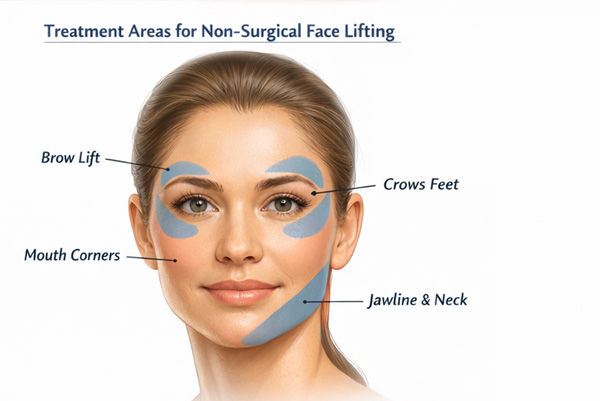
Brow Region
Reducing downward pull can allow the brows to sit in a more open position.
Eye Area
Softening surrounding muscle tension may improve the appearance of tired eyes.
Lower Face
Reducing downward mouth-corner pull can improve resting facial expression.
Jawline and Neck
Reducing platysma tension may improve jawline definition.
Non-Surgical Face Lifting vs Other Facial Rejuvenation Options
Treatment Type | Primary Mechanism | Best For |
Botulinum toxin | Muscle modulation | Muscle-driven ageing |
Dermal fillers | Volume restoration | Volume loss |
Surgical facelift | Tissue repositioning | Advanced laxity |
Each treatment addresses different anatomical causes of facial ageing.
Who May Be Suitable for This Treatment
This approach may be considered for individuals who:
Notice early facial descent
Appear tired or stern at rest
Prefer non-surgical treatment options
Seek subtle and natural changes
It may be less suitable for individuals with advanced skin laxity.
Safety and Medical Assessment
Botulinum toxin injections are medical procedures and should only be performed by trained healthcare professionals.
Possible side effects may include:
Temporary asymmetry
Bruising
Mild muscle weakness
Outcomes vary between individuals, and proper assessment is essential.
Why Anatomy-Based Planning Is Important
Facial muscles function as part of a connected system acting through the SMAS, not as isolated targets.
Treating individual lines without considering global facial dynamics may produce unnatural results.
An anatomy-based approach focuses on:
Restoring facial balance
Preserving natural expression
Achieving subtle improvements in facial posture
Conclusion
Non-surgical face lifting using botulinum toxin represents an anatomy-based approach to facial rejuvenation. By reducing excessive muscle tension and rebalancing directional forces acting on the SMAS, it can create subtle improvements in facial posture and expression.
When guided by detailed anatomical knowledge and careful medical assessment, this treatment may help restore a more rested and balanced facial appearance while maintaining natural movement.
Disclaimer:The information provided in this article is for informational purposes only and is not intended as a substitute for professional medical advice, diagnosis, or treatment. Always seek the advice of your physician or other qualified health provider with any questions you may have regarding a medical condition. The content is not intended to be a comprehensive source of information and should not be relied upon as such. Reliance on any information provided in this article is solely at your own risk. The authors and the publisher do not endorse or recommend any specific tests, physicians, products, procedures, opinions, or other information that may be mentioned in the article. Any reliance on the information in this article is solely at the reader's own risk.
779 Yishun Ave 2, #01-1547, Singapore 760779
Tel: 6721 9796
